
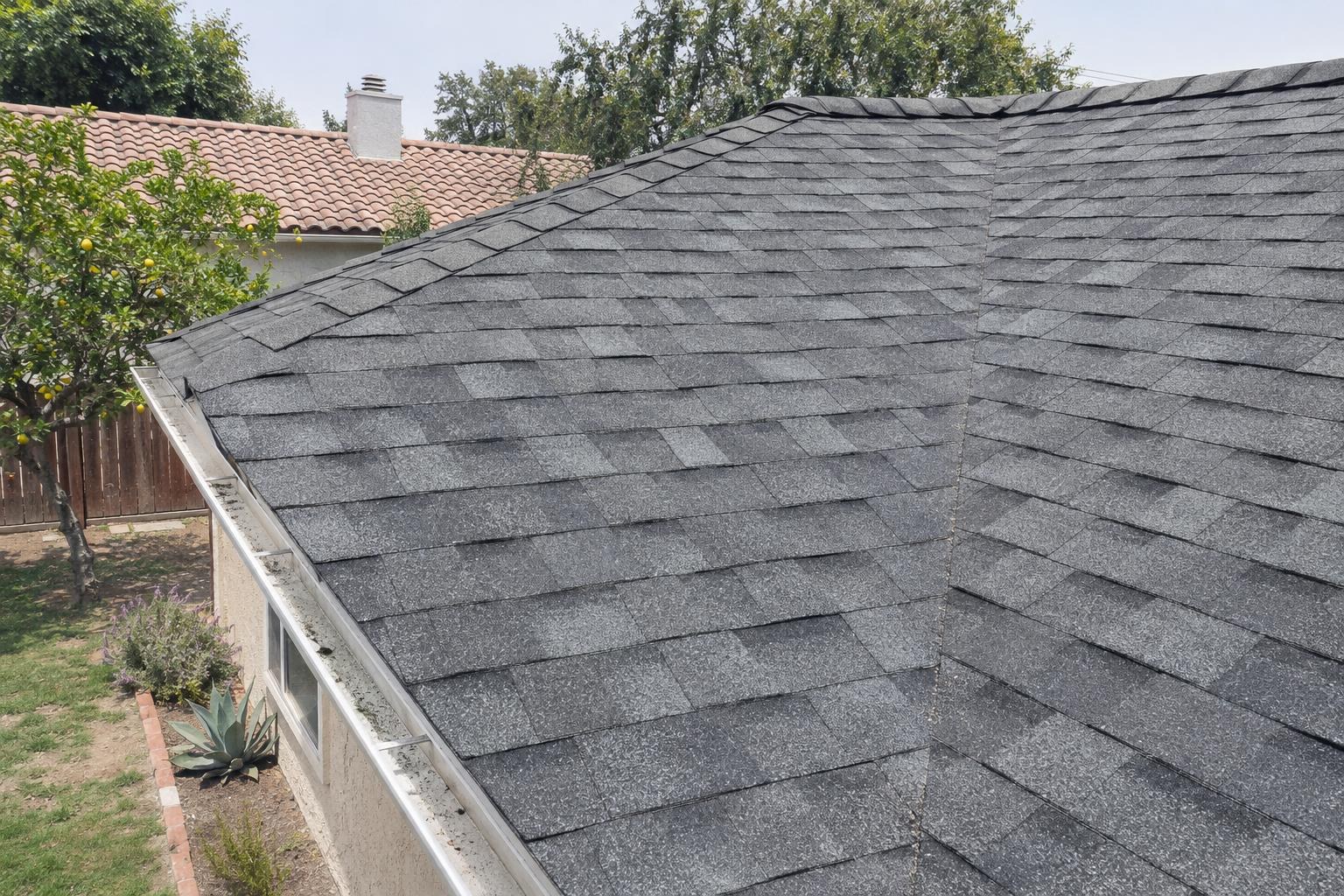
Bellflower gets a mix of roof ages that a lot of nearby cities don't. You've got original 1950s tract homes off Flower Street and Bellflower Boulevard with their original tar-and-gravel or composition shingle roofs long gone through two or three replacements, newer additions tacked on the back with flat or low-slope sections, and Spanish-style homes with clay tile that's older than the current owner. Any contractor who works here needs to be comfortable with more than one roof type, because it's common for one house to have two or three on it at once.
That's the backdrop for why picking the right contractor matters more than people think. A bad roof job doesn't fail the day it's installed. It fails eighteen months later during the first real atmospheric river storm, and by then the contractor who used three roofing nails per tab instead of six is long gone.
Check the license, not just the name on the truck
In California, roofing work requires a C-39 classification from the Contractors State License Board. You can look up any license number on the CSLB website in about thirty seconds and see whether it's active, what classification it carries, and whether there's a bond and workers' comp insurance attached. If a contractor hesitates when you ask for their license number, or gives you a number that comes back expired or under a different company name, that's the end of the conversation right there.
Ask for proof of general liability insurance too. Roofing is one of the more dangerous trades to be on the losing end of if someone falls off your house and isn't covered. You don't want that landing on your homeowner's policy.
What a real bid actually spells out
A bid that just says "reroof house, $9,800" tells you nothing. A real estimate should break down:
- How many squares of roofing (a square is 100 square feet) and what material, by name and brand.
- Whether it's a full tear-off or a layover. California building code allows a maximum of two layers of comp shingle on a roof, and most contractors worth hiring will tear off down to the deck regardless, because you can't see what's wrong underneath a second layer.
- Decking replacement, priced per sheet of 4x8 plywood or OSB, because on an older Bellflower house with skip sheathing or boards from the 1950s, you often don't know what's rotten until the old roof comes off.
- Underlayment type, synthetic or 30-pound felt, and how it's lapped at valleys and penetrations.
- Flashing at chimneys, skylights, and roof-to-wall intersections, replaced, not just caulked over.
- Permit cost included, not an afterthought.
If two bids are far apart, the cheaper one is usually missing one of those items, not finding a better deal on shingles.
The deposit question
California law caps the deposit a home improvement contractor can ask for up front at $1,000 or 10% of the contract price, whichever is less. This is written into the Business and Professions Code, not a suggestion. If someone asks for half the job in cash before they've ordered a single bundle of shingles, they're either unfamiliar with the law or hoping you are. Either way, that's a reason to find someone else.
Permits and inspections in Bellflower
Reroofing in the city goes through Bellflower's building and safety department, and for most reroof or replacement jobs that means a permit pulled before work starts and at least one inspection, usually after the old roofing is off and the deck and underlayment are down but before the new covering goes on. That's the point where a bad decking repair or a skipped layer of underlayment would otherwise get buried forever. A contractor who balks at pulling a permit, or tells you it's not necessary for a reroof, is telling you they'd rather you not have a record of the work or an inspector checking it.
If your property backs onto an unincorporated pocket of LA County rather than the city proper, the permit goes through the county instead, but the principle is the same. HOAs aren't common across most of Bellflower's older tracts, but some of the newer developments do have design standards for tile color or roof pitch, so it's worth a two-minute check before materials get ordered.
What the weather here actually does to a roof
Bellflower doesn't get freeze-thaw cycling the way inland or northern climates do, so that's not what shortens a roof's life here. Two things do the damage locally. First, Santa Ana wind events in the fall, sometimes gusting past 50 mph, which get under loose or improperly nailed shingle tabs and peel them back, especially on roofs that were never sealed down right at the eaves. Second, straight summer UV and heat, with roof surface temperatures well above the 90s to low 100s we see at ground level, which dries out asphalt shingles and ages flat roof coatings faster than people expect. A roofer who's worked here long enough knows to use the right number of fasteners for wind exposure and the right coating reapplication schedule for a flat roof, not just whatever's standard in a manual written for a different climate.
Rain itself is concentrated into a handful of months, November through March, often arriving in a few heavy atmospheric river systems rather than steady drizzle. That means a roof with a weak spot can sit fine for nine months and then leak hard during one storm. If a contractor tells you a small leak repair will hold until next year, ask what happens when 2 inches of rain falls in a day, which does happen here more often than people assume.
Red flags worth walking away from
- Someone who showed up unannounced after a windstorm offering a free inspection and a same-day discount if you sign now.
- No local address or a P.O. box only, especially after a storm when out-of-town crews follow the damage reports.
- A bid with no manufacturer name on the shingle, tile, or membrane.
- Refusal to pull a permit.
- Pressure to make a decision on the spot. A roof is a five-figure decision for most people. One more day to think it over won't change the price.
None of this is complicated once you know what to ask. Most of it comes down to checking a license number, reading a bid line by line instead of just the total, and being willing to say no to anyone in a hurry. If you want a second set of eyes on a quote you already have, or a straight answer on whether a repair will actually hold through the rainy season, that's the kind of question Ridgepoint Roofing Company gets asked all the time, and it's a fair one to ask before you spend the money.